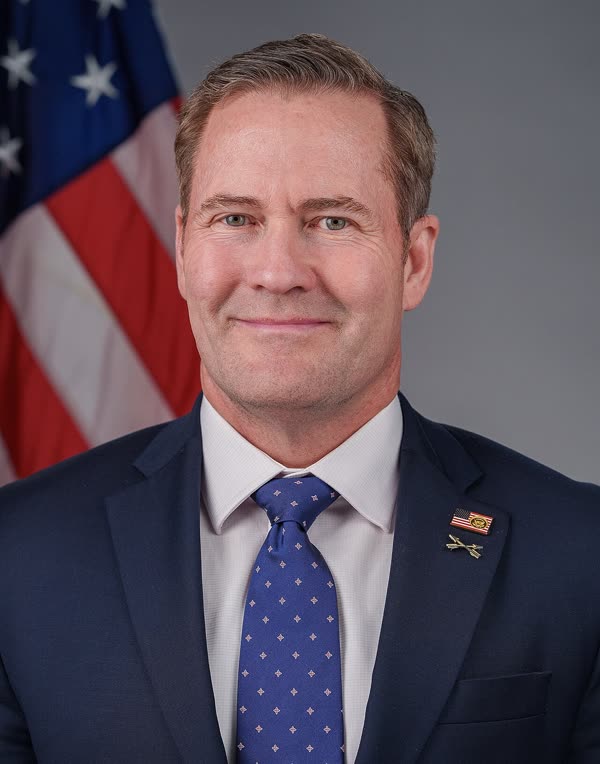
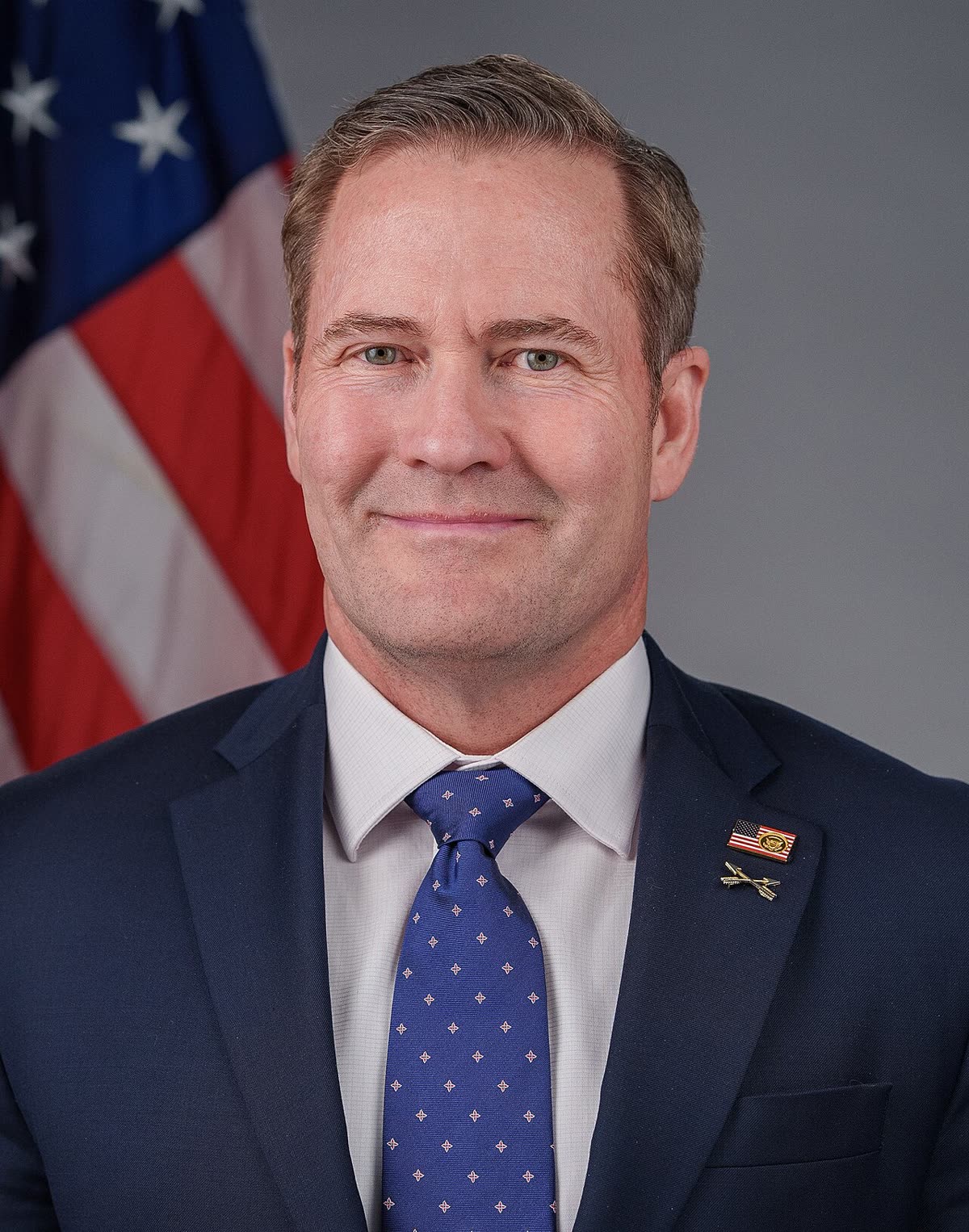
A former Green Beret and Florida congressman who lost the national security adviser job after the Signal chat leak and now defends U.S. military action in Venezuela and Iran at the United Nations.
Biography
Mike Waltz was born on January 31, 1974, in Boynton Beach, Florida, and grew up in Jacksonville. 1 He graduated from the Virginia Military Institute in 1996 and was commissioned as an Army officer. 1 He later qualified as a Green Beret, served in Afghanistan, the Middle East and Africa, earned four Bronze Stars and reached the rank of colonel in the National Guard. 1 He also worked at the Pentagon as a defense policy director and in the White House as a counterterrorism adviser to Vice President Dick Cheney, and in 2010 helped found a defense contracting company. 1
Waltz won a U.S. House seat in northeast Florida in 2018 and was re-elected three times; he was the first Green Beret elected to Congress. 13 He resigned on January 20, 2025, to become Trump's national security adviser. 1 In March 2025 he mistakenly added the editor of The Atlantic to a Signal group chat in which senior officials discussed planned strikes in Yemen. 4 On May 1, 2025, he left the post after 101 days and Trump said he would nominate him to the United Nations instead; sources told CBS News the Signal episode was one of several reasons. 41
The Senate confirmed Waltz 47-43 on September 19, 2025, and he presented his credentials to the U.N. secretary-general on September 21. 312 At his hearing he said the U.N. needed major reform and promised to veto resolutions he considered one-sided against Israel. 5 In November 2025 he helped win Security Council approval of a U.S.-backed resolution authorizing an international stabilization force in Gaza. 1 On January 5, 2026, he told an emergency council meeting that the capture of Venezuela's Nicolas Maduro was a law enforcement action and that the U.S. was not occupying the country. 6
Since the United States and Israel went to war with Iran in 2026, Waltz has been the administration's voice at the U.N. and on television. In March he declined to rule out strikes on Iran's nuclear plants. 7 In July he said a pause in U.S. strikes was meant to give diplomacy room to work. 8 In October, CBS News reported, he told the Financial Times the war could last another year. 9 He remains the ambassador as of November 2026. 2
In the job
The acts and events that have defined the post so far, oldest first.
Confirmed by the Senate 47-43, filling a post that had lacked a confirmed ambassador since January. 32
Helped secure Security Council passage of a U.S.-backed resolution authorizing an international stabilization force and a Board of Peace for Gaza. 1
Told an emergency Security Council meeting that the U.S. operation in Venezuela was the arrest of an indicted drug trafficker, not a war or an occupation. The U.N. secretary-general's office said it was deeply alarmed, and France called the operation a violation of international law. 6
Addressed the Security Council in support of protesters in Iran and said military options remained available. 1
Said on CBS that he would not take any option off the table for the president on bombing Iran's nuclear plants, after Trump threatened Iran's power plants unless the Strait of Hormuz reopened. 7
Said a pause in U.S. strikes on Iran, after 13 straight days of bombing that followed the collapse of a ceasefire, was meant to give diplomacy room, and praised Oman's mediation. 8
Told the Financial Times the war with Iran could go on for another year, according to CBS News. 9
Disputes, and their side
What critics, courts or investigators have said, and the answer given. An allegation is not a finding.
As national security adviser, Waltz created a Signal group chat about planned strikes on Houthi targets in Yemen and added a journalist by mistake. Senate Democrats said at his confirmation hearing that no one had faced consequences, and one accused him of deflecting blame. 45
Their side: Waltz told senators no classified information was shared and that Signal was authorized and recommended for use. He denied he had been fired. 5
U.N. Secretary-General Antonio Guterres said attacks on energy infrastructure by either side in the Iran war could amount to a war crime. Legal experts also criticized Waltz's statements that strikes on Iranian civilian infrastructure would not be war crimes, according to Wikipedia's account. 71
Their side: Waltz said a government that uses critical infrastructure for repression and for its nuclear ambitions makes those sites legitimate targets. 7
Career
U.S. Army active duty as an armor officer; later Special Forces (Green Beret) and National Guard service, retiring as a colonel
Pentagon defense policy director and counterterrorism adviser to Vice President Dick Cheney
Co-founder of the defense contractor Metis Solutions
U.S. Representative for Florida's 6th District
National Security Advisor
U.S. Ambassador to the United Nations
In their own words
Quotes from our stories, each matched word for word against its source before it ran.
“I'm not going to put out hypotheticals. One would hope that they'll come to the table in a meaningful way before that”
A Democratic report says President Trump's oil and gas holdings are worth $22.5 million to $81.6 million, up from $12.6 million to $46 million at the end of 2025. The White House says he has no say in the trades and that there are "no conflicts of interest."
Ambassador Mike Waltz told the Financial Times the U.S. could still be fighting Iran in 12 months. The president first said the war would last "four to five weeks."