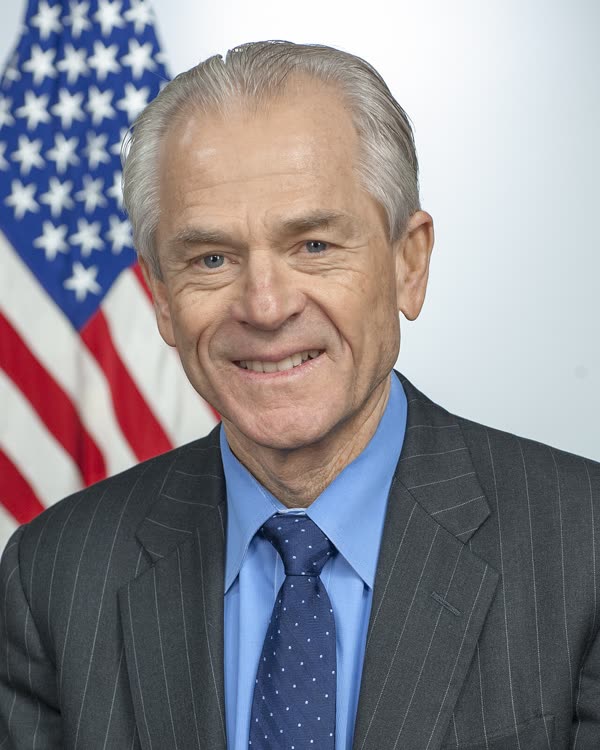
The economist behind Trump's tariff policy, Navarro served four months in prison for defying a January 6 committee subpoena; an appeals court upheld that conviction in July 2026.
Biography
Peter Navarro was born in Cambridge, Massachusetts, in 1949. He studied at Tufts, served in the Peace Corps in Thailand, and earned a doctorate in economics from Harvard in 1986. 4 He joined the University of California, Irvine, in 1989 and taught economics and public policy there for decades. 4 In the 1990s and in 2001 he ran five times for local and federal office in San Diego and lost each race. 4
His books arguing that China's trade practices harm the United States brought him to the Trump campaign in 2016. 4 He ran the White House trade and manufacturing office through the first term. 4 After the 2020 election he refused to comply with a subpoena from the House committee investigating the January 6 attack. A jury convicted him of two counts of contempt of Congress in September 2023, and he served a four-month sentence in a federal prison in Miami in 2024. 1
He returned to the White House in January 2025 as senior counselor for trade and manufacturing, a role similar to his first-term post, and had a central part in the tariffs announced in April 2025. 14 When the Supreme Court ruled in early 2026 that tariffs imposed under an emergency powers law were illegal, Navarro said the outcome was the best possible one for the administration because other tariff laws remained available. 2
On July 21, 2026, a three-judge panel of the federal appeals court in Washington unanimously upheld his contempt convictions. 1 His lawyer said he would keep appealing. 1 The White House release announcing the new chief of staff in November 2026 still listed him under his title. 5
In the job
The acts and events that have defined the post so far, oldest first.
Played a leading role in the reciprocal tariffs announced that month; most were paused for 90 days on April 9. 4
His lawyers argued his appeal alone before the appeals court in Washington because the Trump administration did not defend the conviction. 3
The Supreme Court ruled that tariffs imposed under the International Emergency Economic Powers Act were illegal; Trump then turned to Section 122 of the 1974 Trade Act. 2
Told a Politico economic summit that losing the case was still the best possible outcome because other tariff statutes were left standing. The court had not ruled on those laws. 2
The appeals court upheld his two contempt of Congress convictions. 13
Disputes, and their side
What critics, courts or investigators have said, and the answer given. An allegation is not a finding.
A federal jury in Washington convicted him of two counts of contempt of Congress for refusing to give documents and testimony to the House January 6 committee. He was sentenced to four months and served the term in 2024. The appeals court upheld the convictions on July 21, 2026, finding he had not shown that Trump invoked executive privilege. 1
Their side: Navarro has said he was bound by executive privilege. His lawyer said the ruling was one step in an effort to overturn what he called mistaken precedent and that Navarro would appeal further. 1
The Office of Special Counsel found that he violated the Hatch Act, which limits political activity by federal employees, during the 2020 campaign, according to Wikipedia's summary of the finding. 4
Their side: No public response found.
Elon Musk, then a Trump adviser, publicly attacked Navarro's competence in a dispute over tariffs, according to Wikipedia's summary of news reports. 4
Their side: No public response found in the sources opened.
Career
Peace Corps volunteer, Thailand
Professor of economics and public policy, University of California, Irvine
Candidate in five San Diego races for mayor, city council, county supervisor and Congress (lost all)
Economic adviser, Trump 2016 campaign
Director, White House National Trade Council
Director, White House Office of Trade and Manufacturing Policy
Served four-month federal sentence for contempt of Congress
Senior Counselor to the President for Trade and Manufacturing
Two days after Democrats won the House, Trump's Justice Department renewed its push to wipe out Steve Bannon's conviction for defying a Jan. 6 committee subpoena. The move comes just as Democrats prepare to send their own subpoenas in January.
Ottawa has told its diplomats in the U.S. not to meet or be photographed with midterm candidates. The memo follows Trump administration accusations that Canadian politicians are meddling in the Nov. 3 election.