Courts & Justice · Report · File No. 261119-024
Researchers ask judge to block NIH screen that flags more than 200 'disfavored' terms
Scientists told a San Francisco federal judge that the National Institutes of Health screens grant applications for words like 'gender' and 'climate change.' The judge signaled that some grant cancellations may be unconstitutional, and he plans to rule by the end of the year.
Every quote in this story (2) was matched word for word against its source. How we work
Researchers asked a federal judge in San Francisco on Wednesday to stop the Trump administration from enforcing a screen of National Institutes of Health (NIH) grant applications for more than 200 "disfavored terms." The terms include "gender," "diverse" and "climate change." 1
The researchers say flagged words must be removed and replaced with "preferred phrasing." They say funding could be terminated if the words stay. They argue that this violates their First Amendment free speech rights. 1
They also asked the court to certify two nationwide classes of researchers who are challenging the policies. 1
What the lawyers and the judge said
Vera Eidelman of the American Civil Liberties Union, which represents the researchers, said the government may choose what to fund. But once it funds speech, she argued, it cannot discriminate based on viewpoint. 1
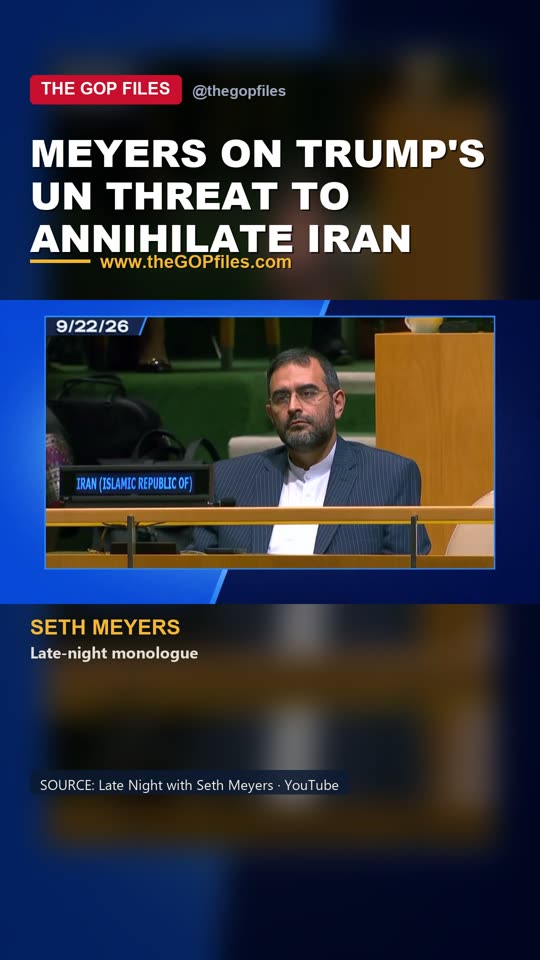 From Channel GOPMeyers on Trump's UN threat to annihilate IranSeth Meyers · 295 plays · captioned, with the source named
The government is not a private funder that gets to say ‘these views are the ones I want to hear.’ Instead, the government is governed by the First Amendment,
U.S. District Judge Vince Chhabria, an Obama appointee, agreed there was a First Amendment issue with the government policing which words researchers use. He was skeptical that canceling grants over policy goals is a violation. He called that view tentative. 1
But he said a past ruling, Thakur v. Trump, likely controls. In that case, a federal judge found that canceling research grants over diversity, equity and inclusion likely violated the First Amendment. The Ninth Circuit Court of Appeals refused to pause that ruling, and the Supreme Court declined to review it. 1
Chhabria said he was inclined to find the grant terminations violate the First Amendment under Thakur. He also leaned toward finding that the screening policies violate Thakur and the Administrative Procedure Act, the federal law that governs how agencies make rules. He said he would likely rule by the end of the year. 1
The government's defense
Jordan Hulseberg, a Justice Department lawyer, conceded that some of the grant terminations are unconstitutional under Thakur. But he argued that NIH's current policies do not discriminate based on viewpoint. 1
Right now, we don’t believe that there are First Amendment problems with the current operative guidance,
Hulseberg said NIH has limited money and should spend it in ways that "maximally benefits Americans." He described research into structural racism as "amorphous." He also said that requiring researchers to use extreme heat instead of climate change was arguably more precise. 1
Where the case came from
The case, Salles et al. v. National Institutes of Health, was filed Sept. 16 by 14 named plaintiffs. The ACLU says NIH uses a list of 235 keywords to flag both funded grants and new applications. 12
The ACLU says other flagged terms include "equity," "racist" and "pregnant individual." It says NIH has asked researchers to remove flagged words from existing awards and ended the grant if they refused. 2
Ann D. Cohen of the University of Pittsburgh is one of the plaintiffs. She said, "Losing this funding has forced us to abruptly cancel appointments for participants." 2
That matters because NIH money pays for studies of conditions common among older Americans, such as kidney disease. Chhabria's example of a terminated grant was one that studied the effect of structural racism on kidney disease. 1
The pattern is a fight over who decides what science gets funded. A ruling is expected by the end of the year. Any order could be appealed. Neither side immediately responded to a request for comment. 1
The Record
Republish this story on your site or in your newsletter
Any site, blog or newsletter may run this story free of charge. Keep the credit line and its link to the original, do not sell it, and edit only for length or house style (the full terms). Photos carry their own licenses, noted under each photo on this page, so use the text alone unless a credit says otherwise.
Paste it into your editor's HTML view. The one-pixel image at the end tells our newsroom the story ran; it stores no reader data.
Sources
- Courthouse News, “Researchers ask to block Trump administration from terminating grants based on ‘disfavored terms’” (2026-11-19). courthousenews.com/researchers-ask-to-block-trump-administra
- ACLU, “Researchers Challenge NIH Screening of Grants for Disfavored Viewpoints” (2026-09-16). aclu.org/press-releases/researchers-challenge-nih-screening-
Found an error? Tell the newsroom. Corrections are noted at the top of the story.
More from the files
HIV researcher forced to drop cash payments from NIH-approved study, Guardian reports
NIH is reviewing grants it says are not in 'alignment' with the Trump administration's priorities and asking scientists to rewrite studies already approved. Medical research that older Americans rely on is being reshaped by politics.
Judge blocks ICE from searching phone of immigration lawyer with know-your-rights page
A federal judge in Boston found an immigration lawyer was likely searched because of his speech. She barred the government from reading data copied from his phone, a ruling that matters for lawyers' privacy and free speech.
Judge extends order blocking Trump's 250-foot arch in D.C. until Dec. 3
U.S. District Judge Tanya Chutkan kept a temporary hold on construction of President Trump's memorial arch. The administration says Congress already cleared the way, and opponents say it did not.
Delivered free to your door*
The Morning Edition
One short email at 7 a.m. Eastern: the day's top files, one clip worth your time, and the race to watch. Plain English, large type, no clutter.
*Your inbox. Free. Unsubscribe with one click, any time.