The U.S. Treasury Department proposed a rule Thursday to crack down on American investments in high-tech fields such as supercomputing and artificial intelligence in China, Russia, North Korea and other "countries of concern." 1 The goal is to keep U.S. money from helping adversaries build military power. 1
The rule would also cover hypersonic systems, which can travel at five times the speed of sound, and biotechnology. 1 Treasury used Trump's favored term for AI, "superintelligence" or SI. 1
What the rule does and does not cover
The rule would apply only to investments above $50,000. 1 It would leave out many financial investments, including stock purchases. 1 So ordinary retirement accounts and index funds do not appear to be the target.
It carries out a law Congress passed in December 2025, the Comprehensive Outbound Investment National Security Act. 1 That law made an existing program permanent and widened it to more technologies and more countries, including Cuba, Iran, North Korea and Russia. 1 A law firm summary says the law was passed as part of the 2026 defense policy bill and signed December 18, 2025. 2
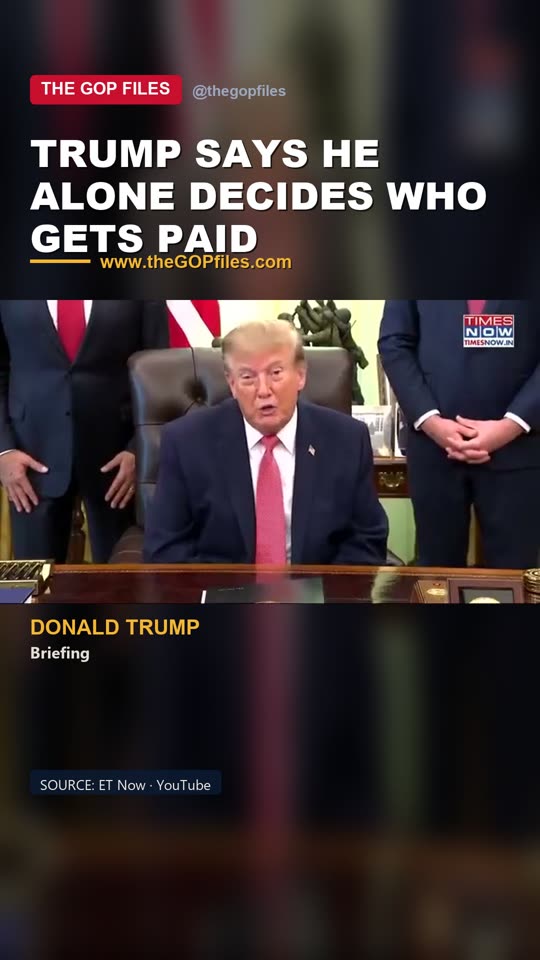 From Channel GOPTrump says he alone decides who gets paidDonald Trump · 121 plays · captioned, with the source named
The program started in 2023, when then-President Joe Biden signed an executive order restricting U.S. investment in Chinese semiconductors, quantum computing and artificial intelligence. 1 Treasury later set up the Outbound Investment Security Program. 1 The law firm summary says Treasury has until March 13, 2027, to issue new or updated regulations. 2
Who said what
Craig Singleton, a senior fellow at the Foundation for Defense of Democracies, a think tank, said the proposal sends a signal that Washington is watching where U.S. money goes. 1 He said screening such investments "recognizes that capital can accelerate military-relevant capabilities just as surely as technology transfer can." 1
sends an important signal to markets that Washington is tracking where U.S. capital is flowing and what capabilities it is helping build,
Ryan Majerus, a former U.S. trade official now at the law firm King & Spalding, called the proposal a first step in a long process. 1 He expects later changes to be "more enforcement-minded." 1
The Russia question
Russia's place in the proposed rule comes days after President Donald Trump waived sanctions on Russia following a diesel deal with Russian President Vladimir Putin. 1 That matters because one arm of the administration is moving to wall off Russia from U.S. capital while another has eased sanctions. This brief cannot say how the two actions fit together, and the wire report does not explain it.
The rule also lands amid a long economic and tech rivalry with China. 1 Trump and Chinese President Xi Jinping agreed last year to ease tensions during talks, and last month they extended that truce into January. 1
Enforcement is not new. In July, Treasury fined a U.S.-based company $200,000 for failing to report a $92,500 investment in a Chinese AI and robotics company made by one of its subsidiaries. 1
What happens next
Treasury will take public comments before issuing a final rule. 1 Jason Chipman, a former Justice Department lawyer now at the law firm WilmerHale, said the rule "will require more substantial compliance programs to manage risk." 1 Until new rules take effect, the existing program stays in force. 2
The Record
- Then-President Joe Biden signs an executive order restricting U.S. investment in Chinese semiconductors, quantum computing and AI; Treasury later sets up the Outbound Investment Security Program 1
- The Comprehensive Outbound Investment National Security Act is enacted as part of the FY26 defense bill, widening the program to more technologies and countries 12
- Treasury fines a U.S.-based company $200,000 for failing to report a $92,500 investment in a Chinese AI and robotics company 1
- Treasury proposes a rule covering supercomputing, hypersonics, biotechnology and AI; public comment will precede a final rule 1
Sources
- ABC News (AP), “US Treasury proposes a rule to crack down on high-tech investments in China, other adversaries” (2026-10-22). abcnews.com/US/wireStory/us-treasury-proposes-rule-crack-hig
- Orrick, “COINS Act Codifies and Expands Treasury Oversight of U.S. Outbound Investments” (2025-12-31). orrick.com/en/Insights/2025/12/COINS-Act-Codifies-and-Expand
Found an error? Tell the newsroom. Corrections are noted at the top of the story.