Social Security & Medicare · Explainer · File No. 261109-196
What happens to your Social Security check if the trust fund runs dry in late 2032
A new Congressional Research Service report says the law doesn't settle whether checks would shrink or come late. Meanwhile, plans to rush a fix through the outgoing Congress have run into opposition from AARP.
Every quote in this story (5) was matched word for word against its source. How we work

Social Security's retirement trust fund is projected to run out of reserves in the last three months of 2032, according to the 2026 trustees report. After that, payroll taxes coming in would cover only about 78% of scheduled benefits. That works out to an automatic cut of about 22% for everyone, including people who are already collecting 1.
Many Americans don't know this is coming. A recent survey by TIAA, the retirement-services company, found that more than one in five Americans don't know their checks could be cut by roughly 20% in about six years, Fortune reported Sunday 1.
A Nov. 2 report from the Congressional Research Service (CRS), Congress's nonpartisan research office, explains what the law says would happen at that point and what it leaves unsettled 2. Here is what older Americans should know as the outgoing Congress meets for its final weeks, known as the lame-duck session, and a Democratic-controlled Senate gets ready to take over 38.
How big the cut would be
The CRS says that when the retirement fund runs dry, money coming in would cover about 78% of scheduled benefits, falling to about 60% by the 2080s. (Its formal name is the Old-Age and Survivors Insurance, or OASI, trust fund.) If it were combined with Social Security's separate disability fund, the joint reserves would last until 2034 and cover about 83% of benefits 2.
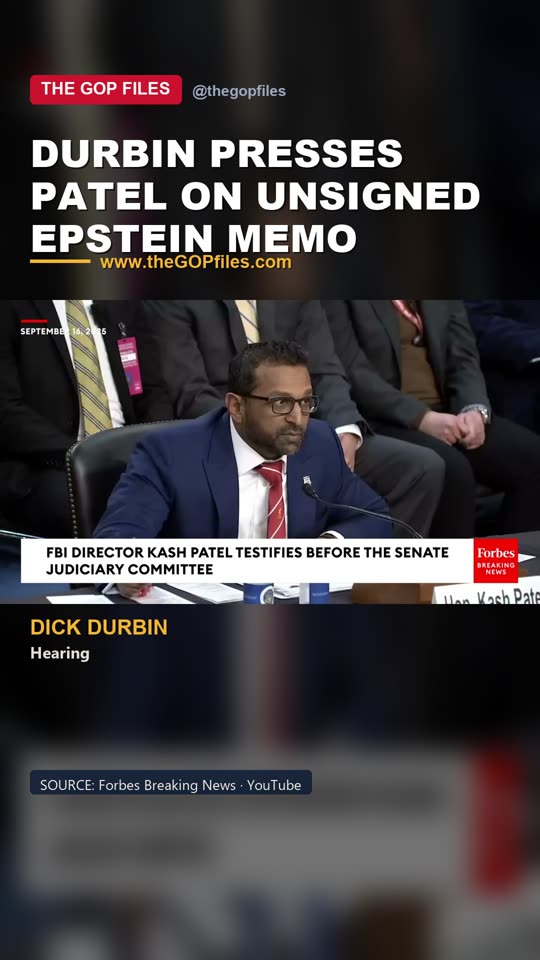 From Channel GOPDurbin presses Patel on unsigned Epstein memoDick Durbin · 2.1K plays · captioned, with the source named
In dollars, the Committee for a Responsible Federal Budget, a budget watchdog group, estimates that a 22% cut would cost a typical two-earner couple retiring in 2033 about $16,900 a year. Social Security pays benefits to more than 71 million people. AARP says it provides most of the income for 43% of seniors 1.
If there's a 22% cut, as we anticipate in 2033, it's going to be a disaster for these families.
Smaller checks, or late ones
The CRS says the law is unclear on this. The Social Security Act lets benefits be paid only from the trust funds, and a separate law, the Antideficiency Act, bars the government from spending money it doesn't have 2.
The report describes two possibilities. Full checks could be paid late, on a schedule no one could predict. Or checks could arrive on time but smaller. The cut could fall evenly on everyone, or some groups, such as disabled or low-income beneficiaries, could be protected 2.
The report also notes that running out of reserves would not end the government's legal duty to pay. Because Social Security is an entitlement, beneficiaries could sue if payments come up short 2.
Why the gap keeps growing
The trustees put the 75-year shortfall at $29.3 trillion in today's dollars, up from $25.1 trillion in last year's report. In 2025, the program took in about $1.45 trillion and paid out about $1.61 trillion, according to a Shenandoah University accounting professor quoted by Fortune 1.
The CRS puts the long-term gap at 4.42% of taxable payroll. That is more than twice the 1.82% shortfall Congress faced in 1983. The report blames mainly demographics: fewer workers are supporting more beneficiaries 2. Another factor is the payroll tax cap. Earnings above $184,500 this year, and above $192,300 in 2027, are not taxed for Social Security 1.
The fixes on the table
The CRS says no single change is likely to close the gap. It will take benefit cuts, new revenue, or both 2. The options being discussed include raising the full retirement age from 67 to 69, raising the payroll tax rate from 6.2% to 7.2% for both workers and employers, lifting the earnings cap to $250,000 or $400,000, and changing the inflation measure used for yearly raises 1.
That matters because these options spread the pain very differently. Raising the retirement age cuts lifetime benefits for anyone who hasn't claimed yet. Raising or lifting the cap asks the highest earners to pay more.
A push to act fast meets resistance
Some senators wanted to settle this after the election. In July, a bipartisan group that included Sen. Dick Durbin, D-Ill., and Sen. Bill Cassidy, R-La., introduced the PROMISE Act 9. It would have the Social Security Advisory Board, a small bipartisan panel, write a plan and send it to Congress under special rules. Passage would still take 60 Senate votes 4. The group saw the post-election session as its best chance 7.
AARP, the largest group representing older Americans, objected in a July 21 letter. It said the bill would set up "fast-tracked floor debates in the lame-duck session of Congress," when members who are leaving office answer less to voters 4. AARP also opposed two commission bills, including the Fiscal Commission Act, for similar reasons 4.
We strongly object to fast-tracking Social Security changes through Congress, as your bill would do
The Fiscal Commission Act (H.R. 3289) is being pushed again. In a Fortune commentary Saturday, former U.S. Comptroller General David M. Walker and Johns Hopkins economist Steve H. Hanke urged the outgoing Congress to pass it before adjourning. They suggested attaching it to a stopgap spending bill, while acknowledging that the bill is stalled 3.
Durbin has been doubtful that anything will pass this year. He told WGLT in September that a bipartisan group of departing senators had tried but lacked support 5.
I'm afraid it won't be done this year. I think that's a missed opportunity.
What the administration says
Frank Bisignano, President Trump's Social Security commissioner, sounded confident in an October interview with CNBC. He also said the White House, Congress and the trustees would ultimately have to work out the money problem 6. Treasury Secretary Scott Bessent argued in June that economic growth could shore up the program without benefit cuts 1. Trump has pledged not to cut Social Security 7.

It's 90 years old, and it'll be around for another 90 years.
The pattern is worth noting. The administration says the program will last, but its Social Security chief said others would have to work out how to close the gap 6. That gap is measured in the trillions in the trustees' own numbers 1.
Any fix will likely need 60 Senate votes and support from both parties. That puts the decision with the 17 new senators arriving in January and with the Democrats who will run the chamber 8.
The Record
- Sens. Cassidy, Cornyn, Durbin, Kaine, King and Tillis introduce the PROMISE Act to set up a process for Congress to vote on a solvency plan 9
- AARP writes to Durbin and Cassidy objecting to fast-tracking Social Security changes, including lame-duck floor debates 4
- Social Security Commissioner Frank Bisignano tells CNBC the program will 'be around for another 90 years' 6
- Congressional Research Service report says the law is unclear on whether checks would be cut or delayed when the trust fund runs out 2
- Fortune reports a TIAA survey finding more than one in five Americans don't know benefits could be cut in about six years 1
Republish this story on your site or in your newsletter
Any site, blog or newsletter may run this story free of charge. Keep the credit line and its link to the original, do not sell it, and edit only for length or house style (the full terms). Photos carry their own licenses, noted under each photo on this page, so use the text alone unless a credit says otherwise.
Paste it into your editor's HTML view. The one-pixel image at the end tells our newsroom the story ran; it stores no reader data.
Sources
- Fortune, “'No vote, no warning, just plain math': Social Security is six years from an automatic 22% cut—and most Americans have no idea” (2026-11-08). fortune.com/2026/11/08/social-security-22-percent-benefit-cu
- Congressional Research Service (via EveryCRSReport), “Social Security: Trust Funds, Financing, and the Projected Shortfall (R49500)” (2026-11-02). everycrsreport.com/files/2026-11-02_R49500_1e2244c90ee3aaf08
- Fortune, “The lame-duck session gives Congress an opportunity to act on the national debt: $40 trillion is just the tip of the iceberg” (2026-11-07). fortune.com/2026/11/07/lame-duck-session-fiscal-commission-a
- CNBC, “AARP opposes bipartisan Social Security reform proposal” (2026-07-23). cnbc.com/2026/07/23/aarp-opposes-bipartisan-social-security-
- NPR Illinois / WGLT, “Social Security fix requires political will that Sen. Durbin says is absent this year” (2026-09-03). nprillinois.org/illinois/2026-09-03/social-security-fix-requ
- Spectrum News, “Bisignano says Social Security will last another 90 years” (2026-10-12). spectrumlocalnews.com/us/snplus/politics/2026/10/12/frank-bi
- The Washington Sun (formerly NOTUS), “A Group of Centrist Senators Sees a Window to Overhaul Social Security” (2026-08-11). washingtonsun.com/economy/centrist-senators-overhaul-social-
- Fortune, “A new group of senators from both parties will vote on how to save Social Security. Here's what they've said about it” (2026-11-07). fortune.com/2026/11/07/social-security-reform-new-senators-2
- Committee for a Responsible Federal Budget, “PROMISE Act Jumpstarts Path Toward Saving Social Security” (2026-07-14). crfb.org/press-releases/promise-act-jumpstarts-path-toward-s
Found an error? Tell the newsroom. Corrections are noted at the top of the story.
More from the files

AARP poll: 90% of older voters want no Social Security cuts as lame-duck Congress returns
AARP's survey of people who voted on Tuesday finds that older voters in both parties want Social Security protected from cuts. Congress returns Monday with the program's 2032 shortfall still unsolved and a fast-track bill that AARP opposes still waiting in the Senate.
Social Security sends fourth Trump-praising email to beneficiaries before midterms
On Oct. 22, less than two weeks before Election Day, the Social Security Administration sent beneficiaries an email praising President Trump and the new 'Trump Accounts' for children. In July, five Democratic senators had told the agency's chief to stop sending messages like this.
Social Security chief calls fraud cleanup the 'first solution' as 2032 shortfall nears
Commissioner Frank Bisignano says cutting fraud, waste and abuse is the first step to protect Social Security. Outside experts say that won't close a gap the trustees project would leave retirement benefits at 78% of scheduled amounts starting in 2032.
Delivered free to your door*
The Morning Edition
One short email at 7 a.m. Eastern: the day's top files, one clip worth your time, and the race to watch. Plain English, large type, no clutter.
*Your inbox. Free. Unsubscribe with one click, any time.